Friday, January 31, 2014

Walter Darling - Colonel, Bartender, Race Horse Owner, Man of the Wild West

St. Johns Herald Newspaper
4 June 1885
As I have been researching old Apache County Newspapers I kept seeing advertisements for the "Monarch Saloon" in St. Johns.  Over the years it changed hands several times - but the name that kept jumping out at me was one Walter Darling.  Once again a name that I had not really heard about in any of the regular 'pioneer' stories of St. Johns.  So I set off on another adventure and the hunt was on - I HAD to find out who this Walter Darling fellow was!


 With just the information I have been able to find it appears that Walter Darling lived in St. Johns and was the proprietor of the Monarch Saloon during the decade of the 1880s.  I have not yet discovered when he first came to St. Johns, but know that he left in the early 1890s.

He seemed to be well-liked and respected (except by a certain Barry Matthews - we'll get to that in a moment) and was involved in many aspects of the community such as participating in Democratic Conventions, feeding and sometimes housing Apache County Prisoners, and more.  He and Dr. Dalby were several times mentioned on forays together indicating that they were somewhat friends.

St. Johns Herald
10 September 1885

"The Monarch saloon has all at once become animated by crowds of people from all parts of the territory.  Darling has provided for the town every sort of amusement, all sorts of eatables and drinkables, every kind of game known in the west from wild turkeys, John Donkey rabbits, stud-horse poker, sage hens from Nevada, monte, little draw, wild pigeons from Stover's preserves, billards in every variety, antelope, grizzly and cinnamon bear to chuck-a-luck, and if you don't see what you want call for it.  This is Darling's lay-out for the festival season."


 I am assuming that "John Donkey rabbits" are jack rabbits - however I have not been able to find out for sure.  This above snippet from 1885 sounds like Walter Darling was providing an amazing array of entertainment and feasting in his little saloon in St. Johns, Arizona Territory.

In1885 he almost suffered a tragic loss as well:
 
St Johns Herald
11 November 1885

"The Monarch Saloon of Walter Darling narrowly escaped destruction by fire on Tuesday morning.  A bundle of straw in the second story, became ignited from the stove-pipe and threatened a serious conflagration.  It was finally extinguished without further damage than a thorough drenching of the building."


However 1885 also held some fun for Darling and St. Johns residents who enjoyed horse races.  July 1885 - Horse Race between Darling's mare "Kate" and Tomas Perez's mare "Dolly".  (Tomas Perez later served as one of Apache County's Sheriffs.)

St. Johns Herald Newspaper
23 July 1885

St. Johns Herald
30 July 1885


And the results: 

"About five hundred people were at the race track Sunday afternoon to witness the running race between Walter Darling's mare, Kate, and Thos. Perez's Dolly.  The race was a 250 yards dash for a purse of $500, Chas. Franklin and Roman Lopez acting as judges...Both horses exhibited speed beyond expectation, and done some fine running, and until within sixty yards of the wire it was difficult to determine which had the advantage, at this point, however, Kate rapidly drew away from her rival and came under the wire about three lengths in the lead.  About $2000 changed hands on the result, besides a large amount of stock."


The biggest drama for the Monarch and Darling ran from October of 1888 through July of 1889, during what appears an ongoing dispute between Walter Darling and a man named Barry Matthews.  Barry Matthews was one-time editor of the St. Johns Herald & it also appears by the following ad found in the newspaper that he was an Attorney:

St. Johns Herald Newspaper
30 June 1887

But from the articles on the several encounters between Matthews and Darling - it is quite apparent that while Darling was well-liked and respected by the townsfolk - Matthews was not, and was apparently doing everything he could to alienate the population and gain a reputation as a "bad man".  It didn't end well for him...

St. Johns Herald Newspaper
4 October 1888
The first encounter I found was in the October 1888 issue of the St. Johns Herald - transcribed here in its entirety:

"We were surprised and shocked to learn that Monday afternoon late, Barry Matthews had seriously, possibly fatally stabbed Walter Darling in front of the restaurant.  As we gathered it, Matthews sometime since, in payment of a long deferred board bill, had sold Darling among other things, a horse for $60.  Darling agreed to take the horse, allow Matthews to use him whenever he chose, and if within six months, he wished it, to see it back for $25.  Recently Matthews took the horse back at the latter price.  On Monday, Matthews being under the influence of liquor, was discussing the matter, and when Darling supposed the discussion over, Matthews called him a liar, stabbed him twice once in the arm and once between the ribs, before he awakened to the situation.  Matthews was arrested on charge of assault with intent to commit murder, and on giving bond in the sum of $1,000 was released.  His examination will be postponed to await the result of Darling's wounds.

Dr. Dalby thinks the cuts are very serious, but not necessarily fatal.  Walter Darling's hosts of friends, of all races and stations, will anxiously await the announcement that he is out of danger.  The situation may be summed up in the language of a common friend of both parties, and that is, 'no man can have a row with Walter Darling and not be in the wrong.'

Matthews, since his residence in St. Johns, has been engaged in several broils.  On one occasion he used his six-shooter as club on Sol Barth - on another he used the same weapon on Harry Silver, and quite recently he was dodging around corners, with Winchester in hand, with the avowed intention of cutting one of our townsmen in two.  It appears to be his ambition to get up a reputation as a 'bad man', and we think that in his endeavor to attain that distinction, he has put himself in a fair way to become a ward of the Territory, and change his place of residence to Yuma..

Since the above was in type we learn that Matthews' bond was placed at fifteen hundred dollars, and that not having given it he is in jail."


St. Johns Herald Newspaper
9 May 1889
Darling did recover from his injuries and it appears that Matthews didn't serve much time for the assault because another encounter occurred just a few short months later that resulted in Matthews' death.  Barry Matthews was once again in the Monarch (having drank to much, which seemed the norm for him) when Walter Darling entered the Saloon and the drunk Matthews started shooting at him.  Darling drew on him, firing back, three shots in rapid succession, each one hitting its target, and killing Matthews.


By July of 1889 the trial was over and Darling was acquitted of the crime (of murder) since he acted in self-defense.  Taken from the St. Johns Herald, 11 of July 1889 edition:

"No case probably in Apache county's judicial history has been more talked of than the indictment of Walter Darling for killing Barry Matthews...the case took one and a half days to try it.  The jury reached a verdict of acquittal on the second ballot, in about one-half hour after retiring...the conclusion generally reached, and often expressed [in the public mind] was, that while it was a misfortune that a man had been killed, yet , the chief source of regret was, that as good a man as Walter Darling should have had the unfortunate necessity forced upon him."

Darling enjoyed more success in St. Johns and took an extended trip back east.  However by 1891 he had sold the Monarch, moved to Albuquerque, New Mexico, and in 1892 it was reported he was opening a saloon in his new home town.


St. Johns Herald
21 July 1892

Monarch Saloon (pictured here when owned by Darling)
From the collection of Barbara Jaramillo as portrayed in the book
 "Images of America - St. Johns" - by Cameron Udall
 
 
Monarch Saloon (pictured here in the 1890s when owned by Jake Armijo)
Jake Armijo behind the counter & Capt. John T. Hogue at the counter.
From the collection of Barbara Jaramillo as portrayed in the book
 "Images of America - St. Johns" - by Cameron Udall
 
 
NOTE:  All newspapers articles quoted and included in this article were gleaned online through the Arizona Digital Newspaper Program - you should check it out! 

Wednesday, November 27, 2013

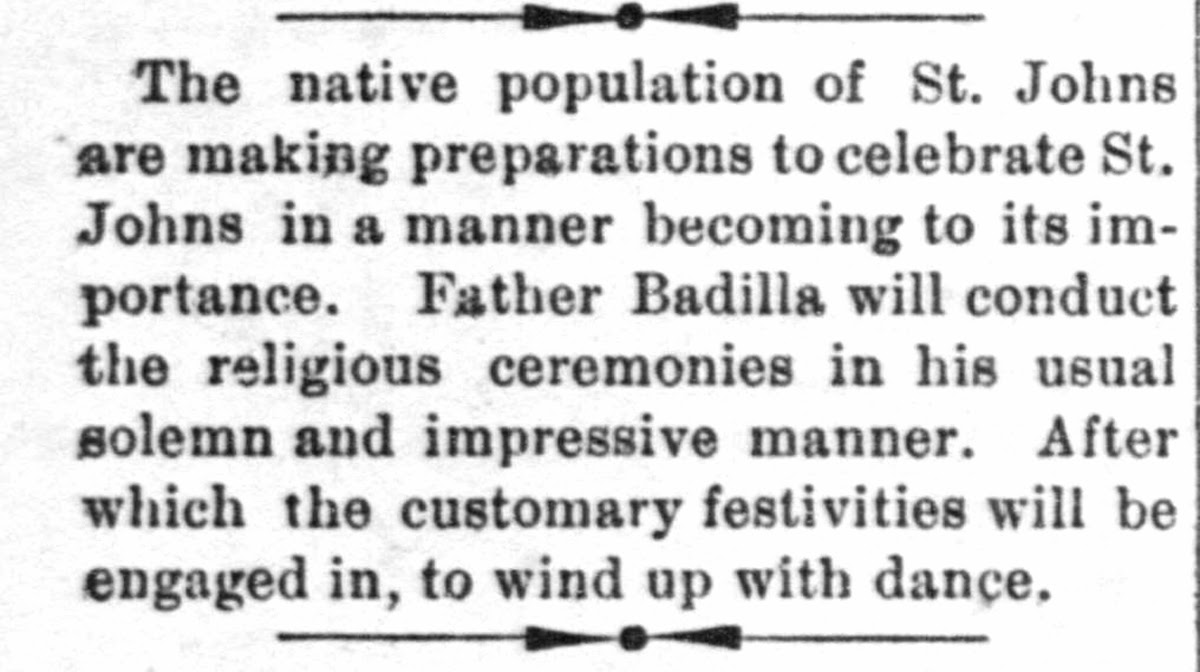
Father Pedro Maria Badilla - 1st Catholic Priest in Apache County

Father Pedro Maria Badilla
When I was doing my research on Genaro Acosta - the St. Johns Pioneer who built many of the Catholic Churches in Apache County, I discovered that his father Lazaro Acosta had written a biography of Father Pedro Maria Badilla - the first Catholic Priest in Apache County.   Another intriguing historical Apache County figure for me to find out more about!  I was so excited!

During my research I was put in contact with several of Genaro Acosta's descendants, including Richard Armijo of the Eastern United States - who graciously sent copies of the Biography (both it's original Spanish version - published in 1910, & the translated English version) to the Museum.   Much of the information I share here today is taken from this biography.

Father Badilla was born 29 June 1827 on a coffee plantation in Heredia, Costa Rica.   After attending the Seminary, he was ordained a priest in Leon, Nicaragua on 8 December 1851, at the age of 24.

Late in 1867 or early 1868 he traveled to Europe where he visited London, Paris, and on to Rome hoping to visit the Vatican and be blessed by the Pope Pius IX, but at the time disease was running rampant in Rome & he was unable to visit the Pope.  He then got on a ship headed for New York, spend a few days there & then went back to Costa Rica.

In 1877 he came back to America spending some time in California.  During this time his parents died and "upon the death of his parents, the priest inherited a small fortune, using his expenditures with intentions that always began with some noble purpose & to do good unto his brethren the poor, never saving anything for himself, he lived meager & this scarcity was one of his most glorious rings."  (From the Biography by Lazaro Acosta).

In the beginning of 1880 Father Badilla arrived in Tucson, Arizona Territory.  At that time early Catholic settlers in Apache County were hoping and "felt it was essential" to form a parish.  The Bishop in Tucson proposed this Parish to Father Badilla, "letting him know how difficult it would be and the dangers of not having a church available, etc.  The worthy Priest welcomed this proposition considering it to be his greatest happiness."  (From the Biography by Lazaro Acosta).


He saw to it that a church was built in St. Johns, working very hard and using some of his own money.  In addition he founded the Catholic Church in Springerville, and also in Concho - again using much of his own money.  (These churches in Concho & Springerville were built by Genaro Acosta.)

He spent 20 years serving the people of Apache County - many times traveling on foot to visit parishioners.   Father Badilla served everyone - and was loved by all of the people, including those of other faiths.  When he passed away in Concho, 3 May 1901, his death was mourned by all.  Father Badilla was laid to rest on the grounds of the St. John the Baptist Catholic Church in St. Johns, Apache County, Arizona.


Here are a few of the articles I found of him in historical Apache County Newspapers:

16 June 1892 - St. Johns Herald Newspaper


18 June 1898 - St. Johns Herald Newspaper


26 June 1897 - St. Johns Herald Newspaper


19 November 1891 - St. Johns Herald Newspaper


29 March 1894 - St. Johns Herald Newspaper


27 June 1896 - St. Johns Herald Newspaper


4 May 1901 - St. Johns Herald Newspaper


This Plaque hangs in the St. Peter's Catholic Church in Springerville


Here are some links to a couple of other websites that have information on Father Badilla:


Sunday, September 22, 2013

Walter G. Scott - continued

Walter G. Scott


Thanks to a heads-up from a co-worker - I found a picture of Walter Scott!  He was actively involved with the National Guard Unit "Company K" in St. Johns for many years.  They met at the Armory Building, that still stands (2013), on main street.  They had weekly drills and stayed prepared for whatever should be needed of them.
The St. Johns Herald - September 1895


Below are a couple of photos of Company K in St. Johns found in Cameron Udall's book - "Images of America: St. Johns, Arizona":


In 1898 he became a volunteer in "McCord's Regiment" during the Spanish-American War.  The regiment was mustered out at Forth Whipple near Prescott, Arizona, and spent some time there before going to Georgia.


His daughter Jessie went to Fort Whipple to see him before they left:

St. Johns Herald News - October 1, 1898


This news snippet to the left indicates they were headed to Lexington, Kentucky, but eventually they were in Camp Churchman at Albany, Georgia.  As indicated in the following letter sent to David King Udall by Walter Scott in December of 1898 - which was then published in the newspaper.


Here is the transcription of the letter:


The following is a letter from Walter G. Scott:  Camp Churchman Albany, Georgia, Dec 26, 1898.

Hon. D. K. Udall.

Dear Sir,

Yours of the 16th, inst and I was very much gratified to hear from you directly.


In regards to the men from St. Johns I would say that they are regarded as among the very best in the regiment.


St. Johns Herald News - January 21, 1899
Upon the organization of the company, Fred Davis was made a sergeant and is now the first duty sergeant of the company.  Elijah Holgate is a corporal, and is now acting in the capacity of postmaster at division headquarters at Columbus.  I think they like him very well at Gen. Sangers headquarters.  Andrew Peterson has been the company clerk ever since we were mustered into the service at Fort Whipple, and has recently been appointed corporal.  These are all the men who came with me from St. Johns.  Not one of them has ever given the officers a bit of trouble, neither have they ever been in the guard house, I am very much gratified in regard to the manner in which these boys has conducted themselves.  They one and all, have done their duty without any shrinking  I do not think that any of them have ever been on the sick report and certainly none of them have ever been a single day in the hospital.  Fred Davis is by far the finest looking man in the regiment, and is also one of the best known.  For the last few week(s) he has been acting as Color sergeant, and he makes a very fine appearance at dress parade as he marches past bearing the regimental flag.  Captain Donoldson of this company together with myself are trying to have him permanently appointed “Color Sergeant”.


You are at liberty to show this letter to all our friends and particularly to the relatives and friends of these men.


Yours truly,

Lieut. Walter G. Scott,

Co. C First Territorial Regiment

U.S.A. Infantry, Camp Churchman, Albany, GA.

The St. Johns Herald - July 8, 1899

Shortly after  returning from serving in the Volunteer Regiment - he purchased the newspaper the "Safford Arizonian" and with his family moved to Graham County, Arizona where he once again worked as a newspaper editor and lawyer:

Transcription of article:  
"The Safford Arizonian has changed hands, A. D. Webb retiring and Walter G. Scott of St. Johns, Apache County taking the helm.  The Arizonian has been an excellent little local paper and Mr. Scott promises to make efforts to continue to merit the support of  Graham county--Arizona Gazette.

The people of St. Johns and Apache co., can assure the people of Safford and Graham Co., that  the Arizonian will continue to be an excellent paper, for Lieut. Scott has been connected with the Herald in the past.  

We shall be sorry to lose Lieut. Scott, from our midst, but our loss will be another's gain.

He and his pleasant family take with them the best wishes of the many friends they leave behind."


I have yet to find his death information.

Saturday, August 31, 2013

Lieutenant Walter G. Scott-McCord's Regiment

Today I am revisiting/updating one of my very first posts.  What a wonderful, fulfilling ADVENTURE this has been!!  Recall (or look back through the posts to the "Forgotten Regiment") that I had found a commemorative poster in the Museum for a Company of Soldiers who served in the Spanish-American War.

I was immediately curious as to why it would be in our little museum.  I was dismayed at the awful state of deterioration, and thus took photos in a preservation effort.  But I also had to to find out more.  What was this all about (and why in the heck didn't I listen in my History classes growing up!?!)

As I began researching the first thing I discovered is mentioned in my first post - and that is about Governor Myron McCord who resigned as Territorial Governor of Arizona to lead an all volunteer regiment in the war.

Governor Myron McCord of Arizona Territory
This is a whole story in itself!  But the goal of this particular "research adventure" was to find out what this Company had to do with St. Johns, and/or what it might have done in St. Johns/Apache County.  As I was perusing historical Arizona newspapers to find information on McCord and his regiment - I hit the jackpot when I came across the following little snippet of news in the Arizona Weekly Journal-Miner of 1898:

6 July 1898-AZ Weekly Journal-Miner


And there was the connection!  "Second company--C.E.Donaldson, of Prescott, captain;  F. C. Hochderfer, of Flagstaff, and Walter G. Scott, of St. Johns, lieutenants."

I could hardly contain my excitement at this discovery!  My research veered off in this new direction - who the heck is Walter G. Scott - not one of the 'usual' historical names I'd heard or become familiar with in connection to St. Johns/Apache County?!

I'd probably not heard of him because he did not stay permanently in St. Johns, and has no descendants here.  So through the mists of time his name has become somewhat lost.  He was only in St. Johns a short 10-year period from 1889 - 1899 - but MY how involved he was, and what a contributor to local history, and the early days of St. Johns.
Walter G. Scott marriage info from Ancestry Library Edition

To my dismay I have not yet been able to find a photo of him (but will not give up on THAT!)  My blog posts will show my love of photographs and visual representations.  But I have found out so much about him.  I share some of it here:

Prior to coming to St. Johns he lived in the Prescott, Arizona area where he worked for the "Arizona Weekly Journal-Miner" newspaper.  He married his bride Mary C. McClellan there in 1888.


Sometime in 1889 they moved to St. Johns.  Where they opened (and Mrs. Scott ran for 7 years 1889-1896)  a little hotel named "Scott House" - what most people probably DON'T know - is that the "Barth Hotel" in St. Johns - was FIRST the "Scott House!!  (Although the building was always owned by Solomon Barth)
11 Jan 1896 - St. Johns Herald News


Prior to being the Barth Hotel (as in this photo) it was the Scott House


4 July 1896-St. Johns Herald


Just some of the roles I have found that Walter Scott played in Apache County are:
  • Notary Public
  • Immigration Commissioner
  • Court Commissioner
  • Newspaper Editor for a time of the St. Johns Herald
  • Captain of a National Guard Unit in St. Johns
  • Attorney
  • District Attorney


28 July 1892-The St. Johns Herald
He was friends with Isaac Barth and there was a group of local men who sure enjoyed their fishing trips to the Black River!  Found several snippets about fishing trips to Black River.


TO BE CONTINUED....


Saturday, August 17, 2013

Genaro Acosta-St. Johns Pioneer & Builder

When I first started my inventory of the files in the archives at the Museum - one of the first things I came across was an excerpt/photocopy from the book "A History of Arizona's Counties & Courthouses" - John J. Dreyfuss, Editor.  The pages about Apache County's courthouse has been copied, but in the same file someone had inserted this handwritten paper:


As I read it - my interest was immediately aroused - who was this "Genaro Acosta" - I don't recall ever hearing the name?  And then I filed that little tidbit of information away in my mind.


But as I continued my researching in early St. Johns/Apache County newspapers I kept coming across an "ad" - or as they were called at that time "professional cards" for Genaro:
St. Johns Herald & Apache News - 30 Apr 1914


And naturally my interest in this gentleman grew!  I HAD to know more!


So I spent some time online - looking at early St. Johns newspapers, and exploring Ancestry Library Edition to try and find out more about him.  And I'm so glad I did!   On Ancestry I was able to find a photo of him!  Always so happy to find a photo because the person becomes that much more 'real'!  (And he's SO handsome!!)

Genaro Acosta


I also found the following information on Ancestry:

"Genaro Acosta also built St. Peter's R. C. Church in Springerville and in Concho, AZ; the R. C. Church and courthouse in McNary, AZ; and the St. Francis [Roman Catholic] Church at the Whiteriver Mission on the Fort Apache Reservation in Arizona."

White River Mission - Genaro Acosta Contractor-1922


Another exciting little tidbit I came across - IF I am interpreting it correctly - led me to discover that I possibly lived for 22 years in a house built by Genaro!!
St. Johns Herald & Apache News - 8 Feb 1917


As I researched him I also learned a little about his father - Lazaro Acosta.  Lazaro was a very educated and talented man.  He worked as the Editor for the Spanish Section of the St. Johns Herald and Apache News for some time:
St. Johns Herald & Apache News-13 Dec 1906

 Another little snippet about Lazaro: 
St. Johns Herald & Apache News - 19 May 1910


And I read somewhere (can't find the reference at the moment) that Lazaro also wrote a biography of Father Pedro Maria Badilla - another early Apache County Pioneer:
Father Pedro Maria Badilla


Genaro and his family eventually settled in Holbrook, Arizona and that is where he & his wife are buried.
Genaro & Faustina Acosta Headstone - from FindAGrave.com

Saturday, August 3, 2013

Spanish Influenza Epidemic of 1918-1919

Spring 1918-Spring 1919: Three waves of highly virulent and fatal influenza sweep the country. The fall-winter wave is the deadliest for the US. The pandemic kills millions and devastates entire communities. 


Arizona

Influenza hit Arizona in late September. The disease probably reached Phoenix first, spreading outward to the rest of the state during the end of September. By October 11th, Flagstaff, Winslow and Holbrook were reporting epidemics. As influenza spread, public health officials were quickly overwhelmed. The epidemic peaked in the state during the first week of November; that week, the state reported deaths from influenza which were four times the state’s annual average.

City officials and residents reacted to the spread of the disease with alarm. Many Arizonans insisted that the disease was spread by dogs. In Phoenix, as police and city residents killed dogs in an attempt to prevent the spread of influenza, the local paper reported that “Phoenix will soon be dogless.” Schools, theaters and other public areas were also closed for three months.


In both Tucson and Phoenix, police arrested residents who ventured out in public without a gauze mask. Officials believed that masks prevented the spread of the disease and had required people to wear these to prevent the spread of the disease. When they passed these requirements, city officials and scientific experts were unaware of the fact that influenza is spread by a virus which is small enough to pass through a gauze mask.

The disease struck the Navajos especially hard. Joseph Schmedding, a trader, who entered a Navajo reservation a few weeks after the epidemic had erupted said that he found 30 Indians, young and old, lying dead in abandoned hogans. In Tuba City, the school was converted into a hospital and the wife of a Navajo trader wrote “for miles around every good winter hogan was deserted [because people feared the infection]. The living moved out into the rain and found what shelter they could in temporary camps.”

The economy also suffered. By late October, reports indicated that mining productivity for the state was off as a result of the pandemic.

After peaking in early November, the disease slowly waned during the late fall and early winter. By the late spring, it had begun to disappear from the state.

From:  United States Department of Health & Human Services


27 March 1919 - St. Johns Herald

 Apache County News Related to the Flu


Expense List for the Spanish Flu - St. Johns - 1919


 I found this original sheet of paper in the Archives of the Museum today.  It is what got me thinking about Apache County and the Spanish Flu.  Edition after edition of the St. Johns Herald & Apache News during this time period list deaths in the area from the Influenza.  I'm sure this was during the period when St. Johns was worst hit.


The aforementioned Dr. Bouldin is not on this list - but it is dated February of 1919 and the doc didn't return from France until June of 1919.  He is mentioned in articles related to the flu after that time.


4 March 1920 - St. Johns Herald

Thursday, August 1, 2013

More on Doctor Bouldin

Just wanted to add a few more items of interest that I found on Dr. Bouldin.  This is an excerpt from the "Transactions of the Medical Association of the State of Alabama":

In this same book it looks as if he attended the Physicians & Surgeons school in Atlanta, Georgia.


During WWI he joined the Medical Corps and I found articles in the historic St. Johns newspapers both of his leaving & his return:
21 March 1918


5 June 1919


Today (August 3, 2013) at the museum I found another treasure - a photo of Doctor Bouldin's wife Ora!!  Beautiful lady!

Ora Bouldin